Breathing Exercises
to Aid in Detox during Fasting
Our lungs are a major eliminative organ for toxins and waste products. By performing breathing exercises, we can enhance the efficiency of this process, increasing air flow for those gas exchanges to take place, and enhancing overall the benefits of fasting.
The biggest gas exchange taking place in the lungs is, of course, between oxygen and carbon dioxide. The blood picks up oxygen from the lungs and lets go of its carbon dioxide. As the blood moves throughout the body, a similar exchange takes place with the cells, as they take in oxygen and give up their metabolic waste product, carbon dioxide. The blood returns to the lungs with its carbon dioxide load, where it is released, and a fresh supply of oxygen picked up.
This process is essential to each and every cell in the body. It is said that all death is caused by loss of oxygen supply to the cells, and that finding a "cause of death" is really about determining what caused the cells to "suffocate".
We can use breathing exercises to improve the oxygenation of our blood and cells. Without the use of breathing exercises or other physical exercise or exertion, our inhalations are usually pretty shallow and only a small portion of the lungs are active in gas exchange. This is the way most us naturally breath while at rest or involved in sedentary activities.
We can stimulate larger portions of our lungs
by doing breathing exercises.
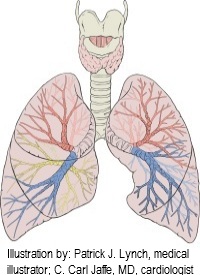
Look at the diagram to the right. Notice the fine pulmonary capillaries that do not receive air flow during shallow breathing. These can become activated by deep breathing, increasing the surface area for gas exchanges of oxygen and carbon dioxide to take place.
Even if you are getting a sufficient amount of physical exercise that creates deep breathing, it is still beneficial to perform separate breathing exercises. They have the additional advantage of providing you time to go inward, to FEEL your body, FEEL your breath. They are physically relaxing and emotionally calming. They can create states of increased consciousness and awareness.
The Breathing Exercises
Some of these exercises will feel wonderful and expansive to you, while others may seem to do nothing. You'll need to experiment. Try those that you are most drawn to and give them your full attention for at least several minutes.
Conscious Breathing
- Sit in a comfortable position, either with your legs folded in front of you or with your feet on the floor.
- Close your eyes and relax completely while keeping the spine erect. Let your shoulders fall naturally. Notice
specifically any tension in your jaw, scalp, and around the eyes. Let it all relax.
- Focus on your breathing, taking even and regular breaths. Watch the process of the in-breath and the out-breath.
Notice the rise and fall of the chest and be sure you're breathing into the abdomen as well.
- Feel the life-giving essence of the breath. Feel it replenish the whole body.
Conscious Breathing Part 2
- Breathe in for a count of seven, hold for a count of seven, then exhale for seven. You may need to start with
less time and work up to seven.
- Some practices suggest you breathe in through the nose and out through the mouth. Others suggest breathing in
and out through the nose.
- As thoughts come up, just watch them float by. If you become distracted by a thought, simply return your
attention to the breath. Don't berate yourself for getting distracted, just let go of the thought and return
your focus to the breath. It's less important that you remain distraction-free, as it is that you learn to
continually realign yourself.
- Keep pen and paper nearby to jot down anything you really need to remember, otherwise your need to remember will become a distraction.
Waiting to Inhale
- Lying down on your back, exhale for as long as you can, counting the seconds. Don't strain, but do attempt
to expel as much air as you can, squeezing in the muscles of the chest and abdomen.
- Inhalation will happen automatically, just release and let the air flow in.
- Try to lengthen the count.
Abdominal Breathing
- Either sitting or lying down on your back, breathe in slowly expanding your abdomen. Feel your diaphragm pushing down.
- Slowly breathe out through your nose pulling the abdominal muscles in, and pressing the air out of the depths of your lungs. Don't strain.
Yogic Breathing using abdominal and chest breathing
- Imagine the lungs divided into upper and lower sections. Inhale deeply expanding the abdomen and filling the lower
section with air, then expand the chest to fill the upper section.
- Reverse the procedure for exhalation: first deflating the chest to empty air from the upper section, then pulling in the abdomen to empty the air from the lower section.
Yogic tradition tells us breathing is closely related to our emotional state. When we are angry or fearful, the breath is very different than when we are calm and centered. Learning to control the breath can help us alleviate the hold our "negative" emotions can seem to have over us.
Next time you are angry or anxious,
calm your breathing and notice how
quickly
the emotion can be transformed.
Breathing exercises are not just for use during a fast or cleansing diet, but are a recommended practice for all times of life. Fasting does, however, present a perfect opportunity to begin, as your attention is focused more inward and your intention is toward greater health and well being. See the Water Fasting Tips page for other activities that are beneficial during fasting or cleansing.
Related Pages
Dry Skin Brushing shares the many health
benefits derived from this quick and easy-to-do practice.How long should you fast? Discover what length of time is best for you and how much preparation is required.
Fruit Fast Details how to do a 1-3 day fast with apples.
Partial Fasting offers easier and gentler methods of fasting.
Understanding What Fasting Is and Is Not will dispel any doubts about fasting being akin to starvation.

Recent Posts


-
Valter Longo and the Longevity Diet
Valter Longo's Longevity Diet, which is a fasting mimicking diet, is showing great promise as a prescribed therapy. If you haven't heard of Valter Longo, check out his newly launched website to follow… -
Fasting Overview for Beginners
Information on fasting especially geared toward the beginner. Important guidelines on fasting including the contraindications and how to do a simple one-day fast. -
Meat vs. Vegan | AllAboutFasting
Confusion seems to arise as to whether this site promotes meat-eating or veganism. Let's set the record straight and talk about ideal diets. Ideal for whom? Each of us individually.